Publications

Papers, preprints, abstracts, and links—organized by year.

My most up-to-date list of papers is usually on Google Scholar, but this page is my tidier, annotated list, with BibTeX, abstracts, and links whenever they are available.

Some datapoints

  1. Erdős number: 3 (for example, Paul Erdős → Noga Alon → Daniel Lokshtanov → me).
  2. Collaborators from: Austria, Chile, China, France, Germany, India, Japan, the Netherlands, Norway, Portugal, Russia, Slovakia, Spain, and the USA.
  3. Most common conference: NeurIPS (five papers). Actively trying to change this 🙃.
  4. Most fun conference: FUN with Algorithms.
  5. Distinctions: Best paper at CICM 2025 and LPAR 2023; distinguished paper at PODS 2025; runner-up for best paper at CICM 2024; best-paper nomination at TACAS 2023; spotlights at NeurIPS 2021 and AFCI@NeurIPS 2020; and first place in the IEEE LA-CCI Latin American master's thesis contest in AI.

Citations by year

615 total citations · h-index 12

Google Scholar · (2026 YTD)

Papers

2026

  1. Computing NP-hard Repetitiveness Measures via MAX-SAT

    Hideo Bannai, Keisuke Goto, Masakazu Ishihata, Shunsuke Kanda, Dominik Köppl, Takaaki Nishimoto, and Bernardo Subercaseaux
    ACM Trans. Algorithms 2026
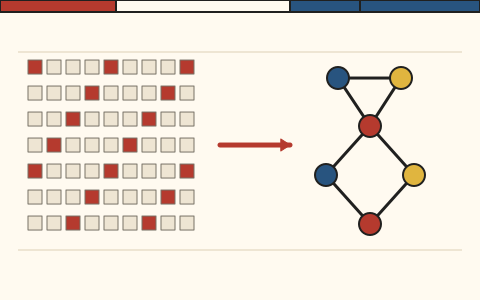
    Three repetitive string measures compressed into compact MAX-SAT encodings.
  2. A Demigod’s Number for the Rubik’s Cube

    Arturo Merino, and Bernardo Subercaseaux
    In FUN 2026
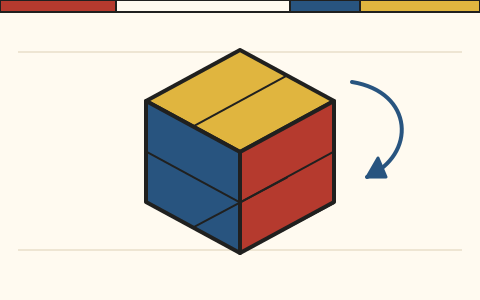
    An isometric three-color Rubik's Cube with a curved move arrow around one corner.
  3. Solving Small Rubik’s Cubes as Slowly as Possible

    Jenny Quan, Noah Kim,  Bernardo Subercaseaux, and John Mackey
    In FUN 2026
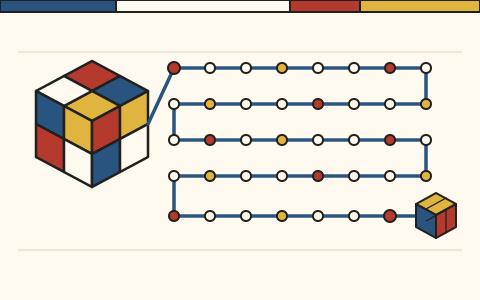
    A scrambled two-by-two Rubik's Cube followed by a long winding path through the puzzle's state space to a solved cube.
  4. Price of Locality in Permutation Mastermind: Are TikTok Influencers Chaotic Enough?

    Bernardo Subercaseaux
    In FUN 2026
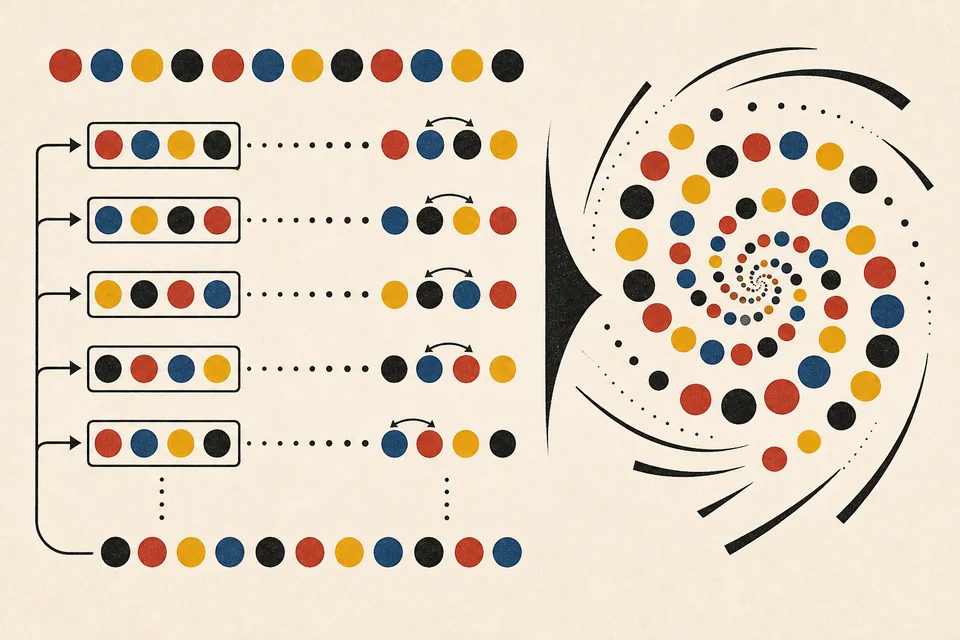
    Orderly rows of colored Mastermind pegs and local swaps opening into a large chaotic spiral of pegs.
  5. Near-Optimal Encodings of Cardinality Constraints

    Andrew Krapivin, Benjamin Przybocki, and Bernardo Subercaseaux
    In SAT 2026
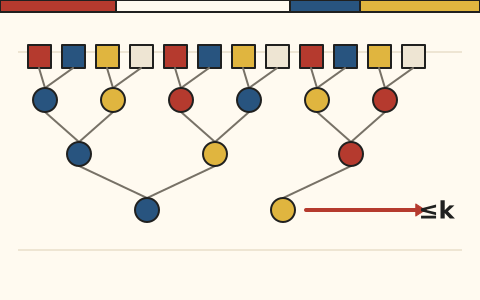
    Boolean inputs passing through a compact hierarchy of cardinality gates to produce an at-most-k count.
  6. Automated Reencoding Meets Graph Theory

    Benjamin Przybocki,  Bernardo Subercaseaux, and Marijn J. H. Heule
    In SAT 2026
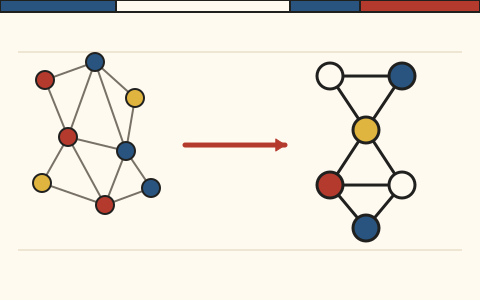
    A dense colored graph being automatically transformed into a smaller, more structured graph.
  7. Optimal and Efficient Partite Decompositions of Hypergraphs

    Andrew Krapivin, Benjamin Przybocki, Nicolás Sanhueza-Matamala, and Bernardo Subercaseaux
    In STOC 2026
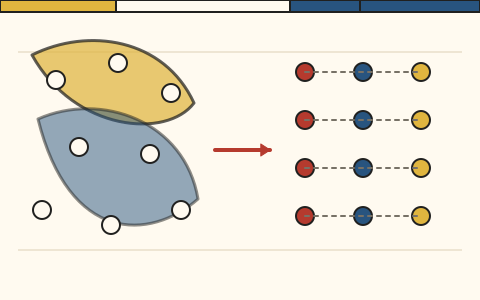
    Overlapping hyperedges separating into three aligned partite columns of colored vertices.
  8. Accelerating Scientific Research with Gemini: Case Studies and Common Techniques

    David P. Woodruff, Vincent Cohen-Addad, Lalit Jain, Jieming Mao, Song Zuo, MohammadHossein Bateni, Simina Brânzei, Michael P. Brenner, Lin Chen, Ying Feng, Lance Fortnow, Gang Fu, Ziyi Guan, Zahra Hadizadeh, Mohammad T. Hajiaghayi, Mahdi JafariRaviz, Adel Javanmard,  Karthik C. S., Ken-ichi Kawarabayashi, Ravi Kumar, Silvio Lattanzi, Euiwoong Lee, Yi Li, Ioannis Panageas, Dimitris Paparas, Benjamin Przybocki,  Bernardo Subercaseaux, Ola Svensson, Shayan Taherijam, Xuan Wu, Eylon Yogev, Morteza Zadimoghaddam, Samson Zhou, Yossi Matias, James Manyika, and Vahab Mirrokni
    CoRR 2026
    Twin star-like agents moving a scientific question through exploration and toward a verified result.
  9. Doubly Saturated Ramsey Graphs: A Case Study in Computer-Assisted Mathematical Discovery

    Benjamin Przybocki, John Mackey, Marijn J. H. Heule, and Bernardo Subercaseaux
    CoRR 2026
    A colored graph being searched and transformed in a computer-assisted Ramsey construction.
  10. On the Complexity of Counting Orderings in Graphs

    Marcelo Arenas, Marı́a Alejandra Schild, and Bernardo Subercaseaux
    CoRR 2026
    Numbered elements arranged into a constrained ordering along a graph.
  11. ExplAIner: A Declarative Query Language for Explaining Classification Models

    Marcelo Arenas, Pablo Barceló, Diego Bustamante, Jose Caraball, Marı́a Alejandra Schild, and Bernardo Subercaseaux
    CoRR 2026
    A classification tree translated into a compact declarative explanation query.

2025

  1. On Computing Probabilistic Explanations for Decision Trees

    Marcelo Arenas, Pablo Barceló, Alexander Kozachinskiy, Miguel Romero, and Bernardo Subercaseaux
    J. Artif. Intell. Res. 2025
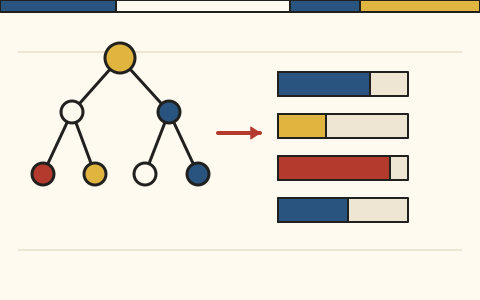
    A colored decision tree leading to four bars representing the probabilities of different explanations.
  2. Explaining k-Nearest Neighbors: Abductive and Counterfactual Explanations

    Pablo Barceló, Alexander Kozachinskiy, Miguel Romero,  Bernardo Subercaseaux, and José Verschae
    Proc. ACM Manag. Data 2025
    • Distinguished paperPODS 2025
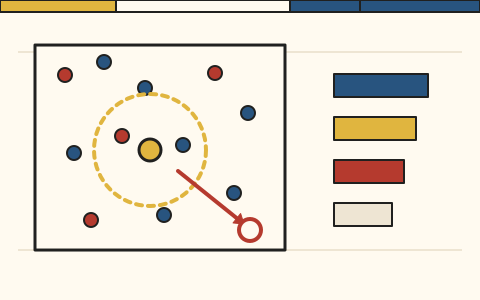
    A query point, its nearest colored neighbors, and an arrow to a nearby counterfactual point.
  3. Probabilistic Explanations for Linear Models

    Bernardo Subercaseaux, Marcelo Arenas, and Kuldeep S. Meel
    In AAAI 2025
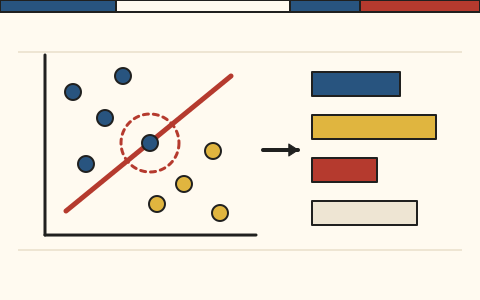
    Two classes of points divided by a linear boundary, with one partial instance highlighted and explained by feature bars.
  4. Unfolding Boxes with Local Constraints

    Long Qian, Eric Wang,  Bernardo Subercaseaux, and Marijn J. H. Heule
    In CADE 2025
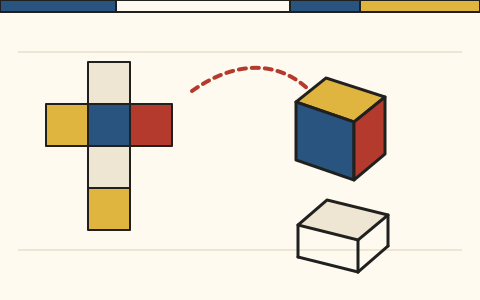
    A colored polyomino net folding along dashed lines into two different rectangular boxes.
  5. Latency Guarantees for Caching with Delayed Hits

    Keerthana Gurushankar, Noah G. Singer, and Bernardo Subercaseaux
    In INFOCOM 2025
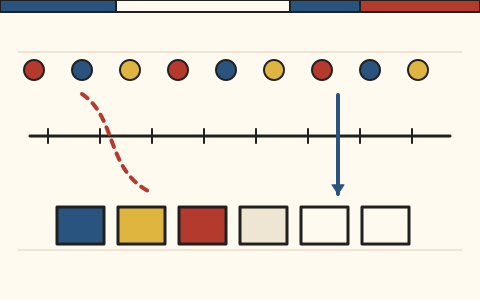
    A stream of colored requests above a cache timeline, with delayed requests curving into their eventual slots.
  6. Automated Symmetric Constructions in Discrete Geometry

    Bernardo Subercaseaux, Ethan Mackey, Long Qian, and Marijn Heule
    In CICM 2025
    • Best paperCICM 2025
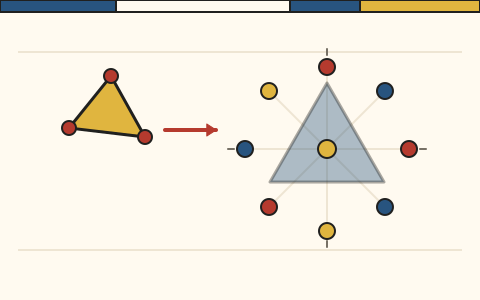
    A three-point seed expanded into an eightfold rotationally symmetric geometric construction.
  7. Asymptotically Smaller Encodings for Graph Problems and Scheduling

    Bernardo Subercaseaux
    CoRR 2025
    A dense rectangular encoding collapsing into a much smaller colored graph.
  8. From the Finite to the Infinite: Sharper Asymptotic Bounds on Norin’s Conjecture via SAT

    Markus Kirchweger, Tomás Peitl,  Bernardo Subercaseaux, and Stefan Szeider
    CoRR 2025
    Three finite concentric graph patterns pointing toward two limiting asymptotic curves.

2024

  1. A Mathematical Analysis of PlaceIt: A Game of Perfect Online Sorting

    Pablo Ruiz Cuevas, Casey Chock, and Bernardo Subercaseaux
    In CG 2024
    A numbered tile falling into a permanently ordered row of online sorting slots.
  2. PackIt!: Gamified Rectangle Packing

    Thomas Garrison, Marijn J. H. Heule, and Bernardo Subercaseaux
    In FUN 2024
    Red, yellow, blue, and ivory rectangles of different sizes forming a nearly perfect rectangular packing.
  3. Formal Verification of the Empty Hexagon Number

    Bernardo Subercaseaux, Wojciech Nawrocki, James Gallicchio, Cayden R. Codel, Mario Carneiro, and Marijn J. H. Heule
    In ITP 2024
    A red six-sided polygon whose interior is visibly empty among a larger set of points.
  4. A Uniform Language to Explain Decision Trees

    Marcelo Arenas, Pablo Barceló, Diego Bustamante, Jose Caraball, and Bernardo Subercaseaux
    In KR 2024
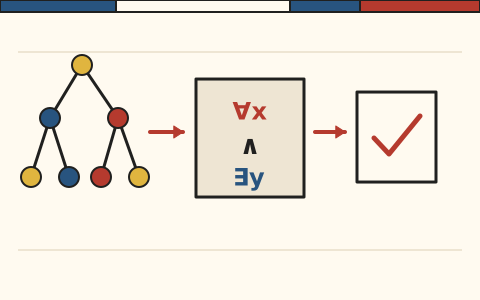
    A colored decision tree translated through quantified logical syntax into a checked explanation.
  5. Sometimes Hoarding is Harder than Cleaning: NP-hardness of Maximum Blocked-Clause Addition

    Bernardo Subercaseaux
    In LPAR 2024
    A red clause added to a stack of clauses, triggering a directed cycle among colored nodes.
  6. Automated Mathematical Discovery and Verification: Minimizing Pentagons in the Plane

    Bernardo Subercaseaux, John Mackey, Marijn J. H. Heule, and Ruben Martins
    In CICM 2024
    • Best-paper runner-upCICM 2024
    Three candidate point configurations passing through an automated proof funnel into a checked certificate.
  7. Assortment Optimization For Conference Goodies With Indifferent Attendees

    Fernanda Gutiérrez, and Bernardo Subercaseaux
    CoRR 2024
    A mixed tray of colorful conference goodies being matched to a line of indifferent attendees.
  8. Pentagon Minimization without Computation

    John Mackey, and Bernardo Subercaseaux
    CoRR 2024
    A field of points with one convex pentagon highlighted in mustard and red.
  9. A proof long enough to stump Leonhard Euler

    Bernardo Subercaseaux, and Marijn J. H. Heule
    Nieuw Archief voor Wiskunde (NAW) 2024
    A very long, machine-checkable proof scroll connecting two colored endpoints.

2023

  1. Toward Optimal Radio Colorings of Hypercubes via SAT-solving

    Bernardo Subercaseaux, and Marijn Heule
    In LPAR 2023
    • Best paperLPAR 2023
    SAT clauses feeding a projected hypercube whose vertices receive distance-constrained radio labels.
  2. The Packing Chromatic Number of the Infinite Square Grid is 15

    Bernardo Subercaseaux, and Marijn J. H. Heule
    In TACAS 2023
    • Best-paper nomineeTACAS 2023
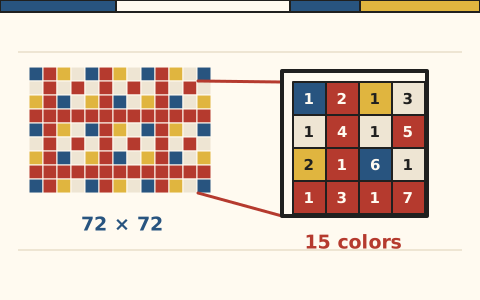
    A dense 72 by 72 packing-color grid connected to a magnified local pattern using fifteen colors.

2022

  1. On the expressiveness of Lara: A proposal for unifying linear and relational algebra

    Pablo Barceló, Nelson Higuera, Jorge Pérez, and Bernardo Subercaseaux
    Theor. Comput. Sci. 2022
    A relational table and a colored matrix joined through one algebraic operator.
  2. Wordle Is NP-Hard

    Daniel Lokshtanov, and Bernardo Subercaseaux
    In FUN 2022
    Four rows of five Wordle-like feedback tiles feeding into a compact hardness constraint.
  3. Augmenting Online Algorithms with ε-Accurate Predictions

    Anupam Gupta, Debmalya Panigrahi,  Bernardo Subercaseaux, and Kevin Sun
    In NeurIPS 2022
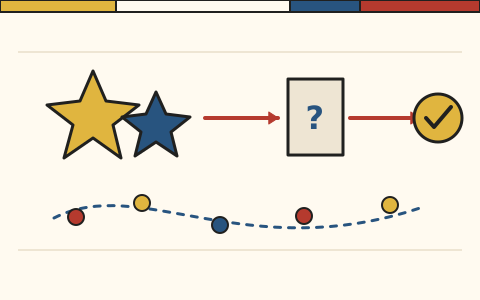
    A dashed prediction curve tracking an actual online sequence and guiding a row of colored decisions.
  4. On Computing Probabilistic Explanations for Decision Trees

    Marcelo Arenas, Pablo Barceló, Miguel A. Romero Orth, and Bernardo Subercaseaux
    In NeurIPS 2022
    A colored decision tree leading to four bars representing the probabilities of different explanations.
  5. The Packing Chromatic Number of the Infinite Square Grid Is at Least 14

    Bernardo Subercaseaux, and Marijn J. H. Heule
    In SAT 2022
    A diamond-shaped patch of the square grid colored with seven distance-constrained packing colors.

2021

  1. The Computational Complexity of Evil Hangman

    Jérémy Barbay, and Bernardo Subercaseaux
    In FUN 2021
    A hand-drawn Hangman figure surrounded by families of words that can shift as the game proceeds.
  2. Foundations of Symbolic Languages for Model Interpretability

    Marcelo Arenas, Daniel Báez, Pablo Barceló, Jorge Pérez, and Bernardo Subercaseaux
    In NeurIPS 2021
    • SpotlightNeurIPS 2021
    A bridge of logical symbols connecting a layered machine-learning model to a verified explanation.

2020

  1. On the Expressiveness of LARA: A Unified Language for Linear and Relational Algebra

    Pablo Barceló, Nelson Higuera, Jorge Pérez, and Bernardo Subercaseaux
    In ICDT 2020
    A relational table and a colored matrix joined through one algebraic operator.
  2. Model Interpretability through the lens of Computational Complexity

    Pablo Barceló, Mikaël Monet, Jorge Pérez, and Bernardo Subercaseaux
    In NeurIPS 2020
    A linear classifier, decision tree, and dense neural network compared through a magnifying glass.
  3. Foundations of Languages for Interpretability and Bias Detection

    Pablo Barceló, Jorge Pérez, and Bernardo Subercaseaux
    AFCI workshop at NeurIPS 2020. Algorithmic Fairness through the Lens of Causality and Interpretability 2020
    • SpotlightAFCI @ NeurIPS 2020
    A bridge of logical symbols connecting a layered machine-learning model to a verified explanation.

2019

  1. Expressiveness of Matrix and Tensor Query Languages in terms of ML Operators

    Pablo Barceló, Nelson Higuera, Jorge Pérez, and Bernardo Subercaseaux
    In DEEM@SIGMOD 2019
    A three-dimensional tensor sliced by a small convolution kernel into a compact colored matrix.

2018

    2017

      2016

      1. Wavelet Trees for Competitive Programming

        Robinson Castro, Nico Lehmann, Jorge Pérez, and Bernardo Subercaseaux
        Olympiads in Informatics Jul 2016
        A colored sequence recursively splitting into a wavelet tree with one query path highlighted in red.